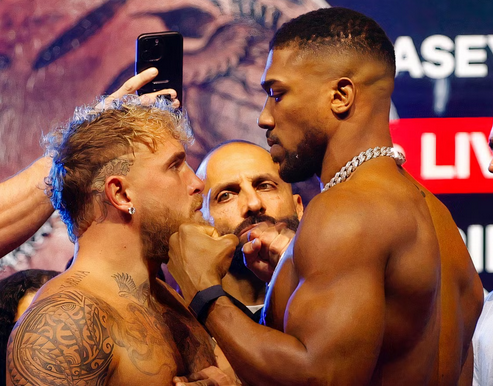
When Anthony Joshua made his professional debut against Emmanuel Leo in 2013, fresh from Olympic gold in London, the boxing world treated it like the start of a coronation.
At roughly the same time, a 16-year-old prankster from Ohio named Jake Paul was posting six-second Vine videos - chatting to pineapples in supermarkets and climbing into strangers' shopping trolleys for a laugh. More than a decade later, through wildly different routes, the pair have arrived at the same place. In Miami, they will share a ring in a professional heavyweight contest that still feels faintly unreal.
"I'm not worried about what people think about the integrity side, I'm more worried about are they talking?" Joshua says.
"That's the whole point of this fight. It creates conversation." Paul says he has no fear and will "shock the world" to become the "king of boxing".
They will fight eight three-minute rounds at the Kaseya Centre, in standard 10oz gloves, under professional rules. Joshua wasn't allowed to weigh more than 17st 7lb (111kg). Otherwise, there are no concessions.
Joshua and Paul were filmed racing speedboats along the Miami River on Sunday, laughing and waving as the skyline slid past behind them. It looked more like spring break than heavyweight boxing. Two days later, Joshua changed the tone entirely by saying "if I can kill you, I will kill you".
Joshua doubled down on those remarks a day later. His comments landed as heavily as his trademark right, a reminder that beneath the Instagram gloss, this is still a professional contest where knockouts are allowed. His power is not a matter of debate, 25 knockouts in 28 wins.
Joshua's stoppage of Robert Helenius was a violent, unsettling finish. Francis Ngannou, a former UFC heavyweight champion, was knocked unconscious by a single punch. Asked directly about safety, Joshua sidestepped the question.
"He's got his groin guard on and his gum shield," Joshua says. "That's the only safety he is allowed." Joshua has promised fans will see the "full" version of himself against Paul - and that is precisely where the concern lies.
"I've never gone in there and knocked someone out within 10 seconds," he adds.
"There's a methodical process to knocking someone out. But if the opportunity presents itself, I'm not planning on carrying Jake for one second more than I have to." It starts, inevitably, with money.
Paul has quickly become boxing's golden ticket - a measure of where the sport's power now sits. The introduction of Netflix has supercharged his power.
The Ohio fighter claimed on social media there is a combined purse of £210m. Joshua has been out of the ring since his defeat by Daniel Dubois in September 2024. He was expected to return in a low-key tune-up. In prize fighting terms, few blame him for fighting Paul for incredible money, but there is more to it.
Joshua remains a popular figure in Britain, a star transcended beyond boxing, but the United States is different. He has boxed in America only once - a shock loss to Andy Ruiz Jr in 2019. With a long-awaited fight against Tyson Fury once again being talked up, Paul may be a useful conduit.
The attention he brings could help widen Joshua's global reach and reignite interest in a bout that no longer sells itself quite as effortlessly as it once did. MVP chief executive Nakisa Bidarian describes it as Joshua's "re-entrance into the biggest market in the world". He added: "America is where the most money is made and where the most eyeballs are.
“This is a smart move." Paul is clear-eyed about the reality. "This is the hardest opponent, hardest challenge, most crazy thing I've ever done in my career," he says.
But the discomfort this fight has generated is familiar territory. Controversy has always been his fuel. He did not flinch at the backlash when he fought a near-pension age Mike Tyson, and he does not appear to care now.
"Who even are these boxing purists?" he jokes. "How pure are they? Do they go to church or something?"
Paul's confidence appears unshakeable. For heavyweight great Lennox Lewis, however, that confidence edges into "delusion". He said: "Anthony Joshua doesn't have two left feet, and he can punch very hard.
"He's going to find out as soon as he gets hit." And there has been some unease within the Paul's camp. Bidarian thought his business partner "was crazy" when it was first raised in March.
"Jake and I are constantly thinking about two, three, four years down the road and how we roadmap his rise to the top of the sport and that completely caught me out of left field," Bidarian says. Paul's fights are frequently accompanied by unsubstantiated claims they are "scripted". Fans on Miami's beachfront described the fight as "fake" but Paul, as ever, spins the suspicion into his favour.
"I take it as a compliment that I am doing something so outrageous and so crazy that people have to write it off," he said. Paul has felt like the A-side this week. In public workouts, Joshua walked out before him.
At media events, Joshua hadn't finished speaking before Paul was ushered in. For some hardcore boxing fans, that inversion is part of the problem. They want the Paul experiment to end. They want the hierarchy restored.
They want proof that boxing still has levels you cannot skip, no matter how many followers you bring with you. "I'm carrying boxing on my back," has been Joshua's mantra all week.
This will decide whether that hierarchy can be restored.