

U.S. secretaries of state have long paid visits to other countries bearing gifts, and receiving them, on behalf of Americans.
While some extravagant gifts have been given to America by other countries — the Statue of Liberty by the French in 1886 or 3,000 cherry trees by the Japanese in 1912 — gift-giving traditions have formalized only in the last century. After President Martin Van Buren declined two Arabian horses from the Imam of Muscat in 1840, President James Polk worked with the U.S. attorney general to formalize gift-giving by U.S. presidents.
For the century that followed, gifts were mostly exchanged between heads of state. Still, there were instances when a U.S. secretary of state marked an occasion by proffering a gift.
The opening of trade relations with Japan was commemorated in 1860 by Secretary of State Lewis Cass giving Japanese diplomats medals that bore the image of then-President James Buchanan. Presented in an elaborate box, the medals were gold, silver or bronze and distributed based on the recipient’s official rank.
Dean Acheson was the first secretary of state to bring a gift on an official visit, when in 1952 he visited Brazil to underscore the importance of South America to the United States. After bearing that first “official” gift from a top U.S. diplomat, Acheson said: “I return to the U.S. with a lift of spirit which I have not had since I became secretary of state.”
Every year the U.S. Congress appropriates funds for diplomatic gifts. The Office of the Chief of Protocol advises the president, the vice president and the secretary of state on the selection of appropriate gifts for visits and meetings with leaders of foreign countries in compliance with federal regulations.
When a gift is given to the secretary of state by another country’s foreign minister or head of state, the protocol office has it appraised. A secretary of state may keep a gift only if it is valued under a designated monetary amount. If it exceeds the designated amount, the official may purchase the gift from the U.S. government at its appraised value.
A final destination for many diplomatic gifts is the National Museum of American Diplomacy . Located at the State Department, the museum features artifacts such as a gold fountain pen received in 1928 by Secretary of State Frank B. Kellogg from the mayor of Le Havre, France. The golden fountain pen was used to sign the Kellogg-Briand Pact, which sought to make war an illegal act following World War I.
It is inscribed with a Latin phrase that translates into English as, “If You Want Peace, Prepare for Peace,” a reminder of the importance of diplomacy. Also in the collection is a quilt given to Secretary of State Condoleezza Rice upon her 2006 visit to Liberia for the inauguration of Ellen Johnson Sirleaf.
Liberia’s 1847 beginnings were supported by language borrowed directly from the American Declaration of Independence, and the quilt is an homage to the U.S. role in Liberia’s founding and a tribute to America’s own quilt-making traditions. Keith Lipert, a gallery owner who procures gifts for world leaders, believes it is not their value that makes the biggest impression.
He says gifts “develop trust between people and allow them to tell their stories.” They “anchor a memory to an occasion,” he says.
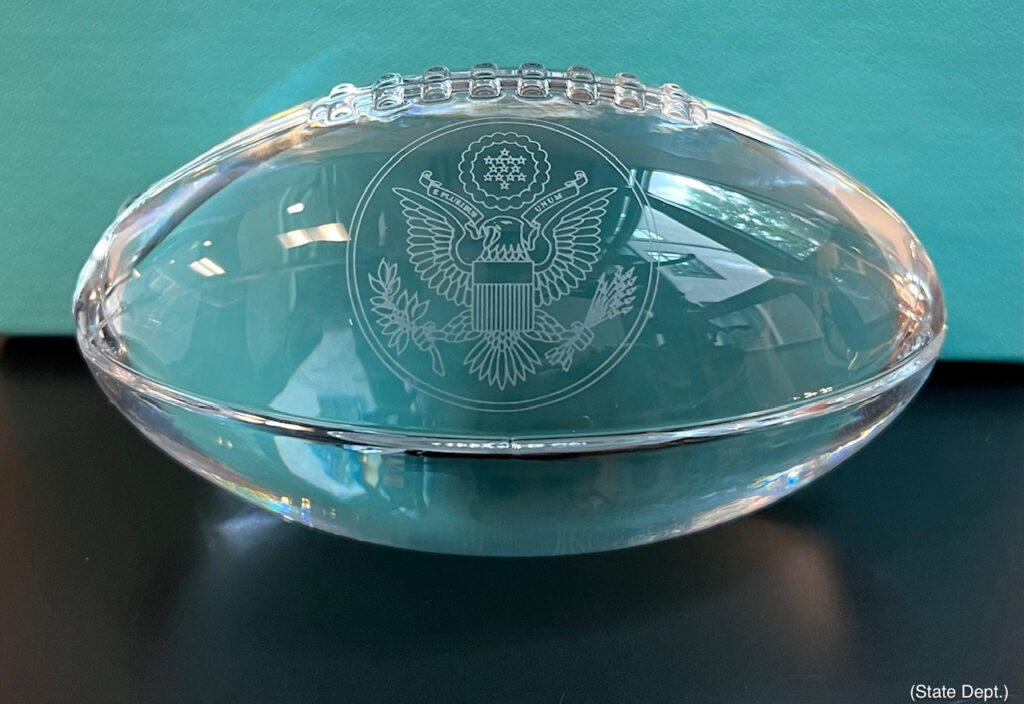
U.S. diplomacy might depend on gifts that showcase unique aspects of America. Football, a sport increasingly embraced around the globe, inspires football fan Secretary of State Marco Rubio to give other countries’ officials a Tiffany & Co. crystal football embossed with the Great Seal of the United States. During President Trump’s first term, Lipert advised the White House on an appropriate gift for Great Britain’s Queen Elizabeth II.
Knowing the queen’s fondness for horses, Lipert suggested a pewter horse as a way to make a personal connection. Such gifts, chosen to say something about a country’s culture or to help build a personal relationship, are the ones that Lipert says are the most diplomatic.