
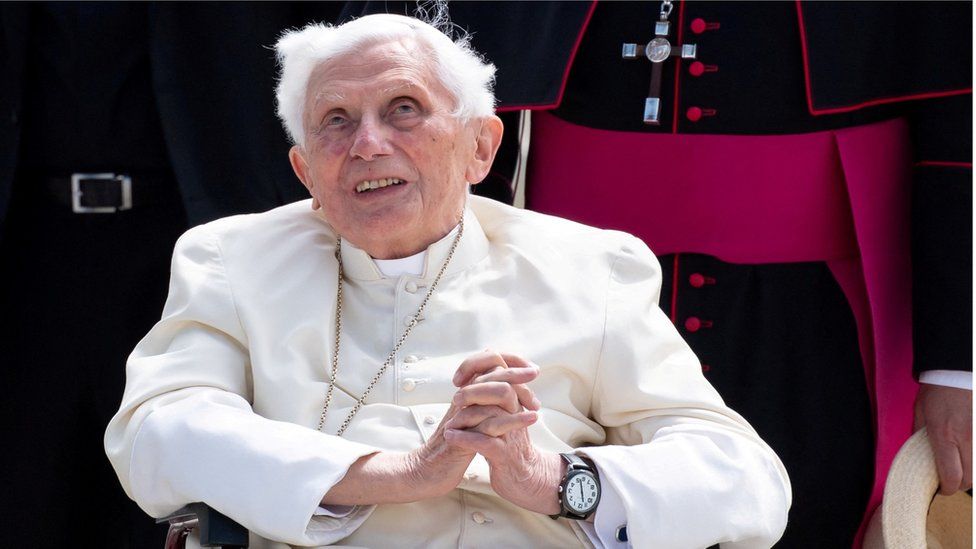
Former Pope Benedict XVI died almost a decade after he stood down because of ailing health.
He led the Catholic Church for fewer than eight years until, in 2013, he became the first Pope to resign since Gregory XII in 1415.
Benedict spent his final years at the Mater Ecclesiae monastery within the walls of the Vatican where he passed away at 09:34 (08:34 GMT) on Saturday.
His successor Pope Francis will lead the funeral on 5 January.
The Vatican said the body of the Pope Emeritus will be placed in St Peter's Basilica from 2 January for "the greeting of the faithful".
Bells rang out from Munich cathedral and a single bell was heard ringing from St Peter's Square in Rome after the former pope's death was announced.
Media caption,
Watch: Pope Benedict XVI through the years
The head of the Catholic Church in England and Wales, Cardinal Vincent Nichols, said Pope Benedict was "one of the great theologians of the 20th century".
In a statement he said: "I remember with particular affection the remarkable Papal Visit to these lands in 2010. We saw his courtesy, his gentleness, the perceptiveness of his mind and the openness of his welcome to everybody that he met."
British Prime Minister Rishi Sunak called the former pope "a great theologian whose UK visit in 2010 was an historic moment for both Catholics and non-Catholics throughout our country".
French President Emmanuel Macron said Pope Benedict "worked with soul and intelligence for a more fraternal world" and said his thoughts went out to Catholics in France and around the world. Italy's Prime Minister Giorgia Meloni said that Pope Benedict was a giant of faith and reason.
"He put his life at the service of the universal Church and spoke, and will continue to speak, to the hearts and minds of men with the spiritual, cultural and intellectual depth of his Magisterium." The German chancellor, Olaf Scholz, said for many, not only in Germany, Pope Benedict was a formative figure of the Catholic Church, a controversial personality and a clever theologian.
Irish President Michael D Higgins said the former pope will be remembered for his untiring efforts to find a common path in promoting peace and goodwill throughout the world. Archbishop of Canterbury, Justin Welby, described Pope Benedict as one of the greatest theologians of his age - committed to the faith of the Church and stalwart in its defence.
In his New Year address, Russian President Vladimir Putin praised Pope Benedict as a defender of traditional Christian values. Following news of the former pope's death people began gathering in St Peter's Square in Rome.
Although the former pontiff had been ill for some time, Vatican authorities said there had been an aggravation in his condition because of advancing age. On Wednesday, Pope Francis appealed to his final audience of the year at the Vatican to pray a special prayer for Pope Emeritus Benedict, whom he said was very ill.
Born Joseph Ratzinger in Germany, Benedict was 78 when in 2005 he became one of the oldest popes ever elected. For much of his papacy, the Catholic Church faced allegations, legal claims and official reports into decades of child abuse by priests.
Earlier this year the former pope acknowledged that errors had been made in the handling of abuse cases while he was archbishop of Munich between 1977 and 1982.
He was 95.