
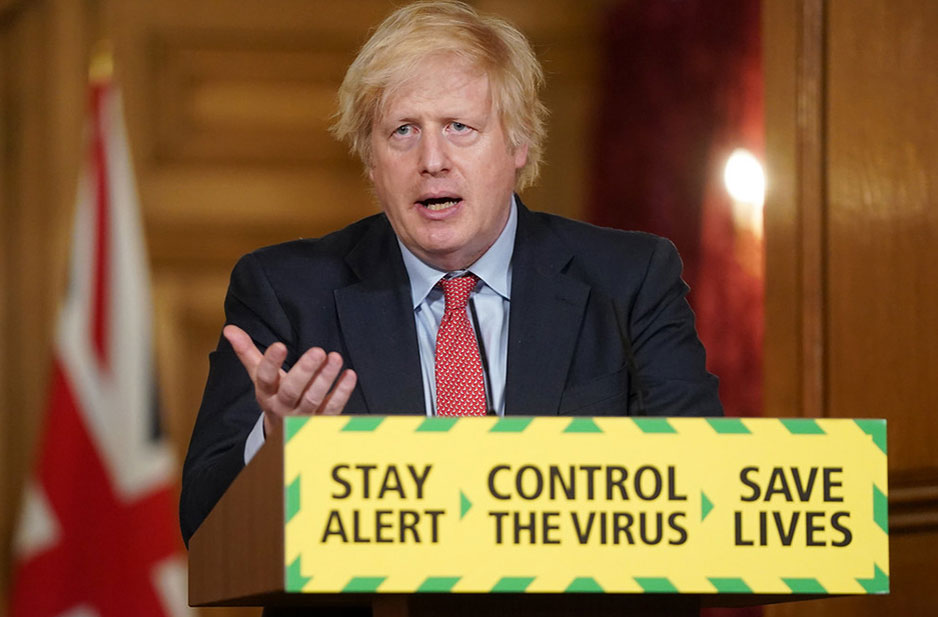
Coronavirus restrictions will ease further in England under plans for a "significant return to normality" by Christmas, Boris Johnson has announced.
Under the new guidelines, people may use public transport for journeys immediately, while advice for employers will change from 1 August. Companies will have more discretion to bring staff back to workplaces if it is safe to do so, the PM explained.
Mr Johnson added he was "hoping for the best and planning for the worst".
At a news conference at Downing Street, the prime minister said the plans "remains conditional" on continued progress in controlling the virus and preventing a second wave of infections that could overwhelm the NHS.
"It is my strong and sincere hope that we will be able to review the outstanding restrictions and allow a more significant return to normality from November at the earliest - possibly in time for Christmas," he said.
Devolved administrations in Scotland, Wales and Northern Ireland have the power to set their own timings for the easing of restrictions.
In the announcement, Mr Johnson said the government was making it clear to people in England they may use public transport now.
From 1 August, he said: "Instead of government telling people to work from home, we are going to give employers more discretion, and ask them to make decisions about how their staff can work safely." He explained that could mean "continuing to work from home, which is one way of working safely and which has worked for many employers and employees".
However, the Welsh government said it would carry on advising people to work from home.
Responding to Mr Johnson's announcement, First Minister Mark Drakeford said: "I positively don't want people to be returning to offices in the way that we did before coronavirus happened." The government's current social distancing guidance requires people to stay at least 1m apart with certain precautions.
A further 114 coronavirus deaths were announced, taking the total number of people who have died with the virus in the UK to 45,233.
Tthe government's chief scientific adviser, Sir Patrick Vallance, told MPs there was "absolutely no reason" to change the government's current guidance on working from home.
They have advised people to "work from home if you can" since March, and Sir Patrick said home working was still a "perfectly good option" for many.
Asked about those comments at the news conference, Mr Johnson said he "totally agrees" with Sir Patrick and that it was not for the government to tell employers where their workforce should be.
Labour leader Sir Keir Starmer said he will look at the details of the government's plan to get people back to work but stressed "this can't be done on a wing and a prayer and requires a credible plan and national leadership".
Business groups warned any mass return to work immediately was unlikely.
Smaller companies in particular would need more support to get workers back, Mike Cherry from the Federation of Small Businesses said. "Small firms are being tasked with consulting employees and putting the right measures in place to ensure a safe return to work," he said.
"After weeks of little or no income, they will need help - both funding and advice - to make that happen."
Director of Policy at the Institute of Directors, Edwin Morgan, said childcare and concerns about using public transport were still issues for many employees.
Trade union body the TUC accused ministers of "passing the buck on this big decision to employers" and said more investment in public transport would be needed to make commuting safer.