
The Midlands-based charity zoo is pleased to announce the successful arrival of two Humboldt penguin chicks and a baby De Brazza’s monkey, both species which are part of important European conservation programmes.
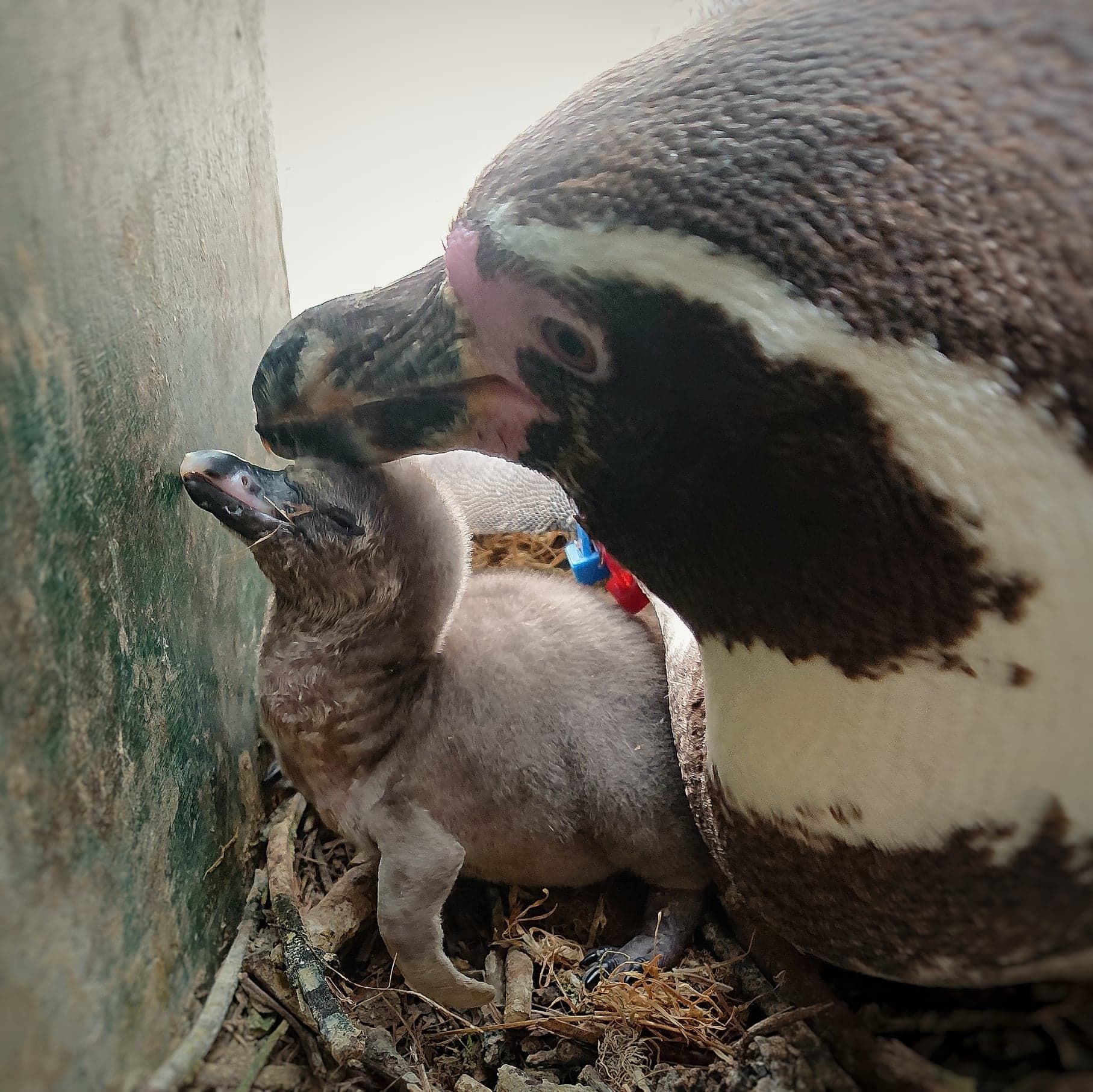
The Humboldt penguin chicks, recently hatched, are thriving in their nest boxes, where they will remain until they reach approximately 70 days old, cared for by both mum and dad. As they emerge, they’ll be noticeable to visitors at Twycross Zoo, retaining their distinctive fluffy grey juvenile feathers for another year.
Humboldt penguins are known for their monogamous partnerships, and these two chicks come from experienced parents who have successfully bred at the zoo before, making another vital contribution to the EAZA Ex-situ Programme (EEP) – which aims to create a healthy population of endangered species, in zoos, to act as a support for their wild counterparts. Over the past 4 decades, Humboldt penguins have experienced significant decline due to habitat loss and the impacts of climate change.
Twycross Zoo is proud to play a crucial role in their conservation. Adding to the arrival of the chicks, Twycross Zoo is also celebrating the birth of a De Brazza’s monkey.
As a first-time mother, the young female is displaying exceptional maternal instincts, successfully rearing her newborn. Her confidence stems from watching and learning from older female primates within her group – a natural behaviour that helps ensure successful parenting.
Having observed multiple births during her early years, she was well-equipped to embrace motherhood herself. Matthew Ford, Curator of Primates at Twycross Zoo, commented on the new arrivals: “Every birth at Twycross Zoo is a testament to the dedication of our team and the collaborative efforts of the EAZA Ex-situ programmes.
“They highlight the important role zoos play in safeguarding wildlife for the future, ensuring we maintain a genetically diverse population of species facing extinction, to act as a support system for their wild counterparts. It's particularly exciting to see animals thriving under our care and helping to contribute to vital conservation efforts.”
The newborn De Brazza’s monkey, part of an EEP, represents an important addition to the species population. Although for now baby remains closely bonded with its mother, zookeepers will be able to determine the sex in the coming months as it gains confidence and begins to explore independently.
Twycross Zoo remains dedicated to inspiring visitors and supporting global conservation initiatives. As a charity, visitors can support this work by purchasing a ticket, where they will also benefit from gaining 12-months of zoo entry for the price of a day.
The zoo is a registered charity (501841) which exists to support the conservation, education and research of some of the most endangered species on the planet. It is the only UK zoo home to four great apes – chimpanzee, gorilla, orangutan and bonobo; and as part of its 2030 Strategy is working at the forefront of conservation and scientific research to become a global force in biodiversity conservation.
One of the UK’s major charity zoos, it cares for hundreds of animals from around 70 different species, whilst welcoming around 700,000 visitors a year to its 100-acre site in Leicestershire. As a member of European and international organisations, Twycross Zoo is also part of the British and Irish Association of Zoos and Aquariums (BIAZA), the European Association of Zoos and Aquaria (EAZA), and the World Association of Zoos and Aquaria (WAZA).